 comparison
Solid Wood vs Particle Board Furniture
Table of Contents
- Solid Wood vs Particle Board: Key Differences at a Glance
- What Is Solid Wood Furniture?
- What Is Particle Board?
- How to Identify Solid Wood Furniture
- Durability, Lifespan, and Load-Bearing Capacity
- How to Care for Walnut Wood Furniture and Other Hardwoods
- Repairing Damaged Particle Board Furniture
- Cost, Moisture Resistance, and Long-Term Value
Last Updated: August 20, 2026
Solid Wood vs Particle Board: Key Differences at a Glance
When shopping for furniture, the material choice determines durability, repairability, and long-term value. Solid wood and particle board represent two entirely different approaches: one uses real hardwood throughout, the other uses wood fibers compressed with adhesive resins. At Pinnacle Woodcraft, LLC, we've built our reputation on understanding these distinctions because they matter for every piece that enters your home.
This guide breaks down the practical differences so you can make an informed choice for your space.
What Is Solid Wood Furniture?
Solid wood furniture is built from lumber cut directly from trees, typically hardwoods like walnut, oak, maple, or cherry. Every structural component consists of actual wood rather than composite materials.
The construction process involves selecting boards, milling them to size, and joining them with solid joinery (mortise-and-tenon joints, dovetails, or dowels). Quality solid wood furniture is recognizable by its weight, feel, and grain variation. Each piece shows unique character because real wood moves and ages visibly. A walnut table will look different at year five than at purchase, the finish deepens, and the wood develops a patina that mass-produced items cannot replicate.
Solid wood responds to environmental conditions. In dry climates, it may shrink slightly; in humid environments, it may swell. These movements are normal and manageable. Well-built solid wood accommodates these changes through traditional joinery that allows the wood to move while maintaining structural integrity.
What Is Particle Board?
Particle board is an engineered wood product made from wood chips, sawdust, and wood residues bonded together with formaldehyde resins under heat and pressure. The result is a dense, flat sheet material that's inexpensive to produce and uniform in appearance.
Particle board offers cost advantages and consistency, making it ideal for flat-pack furniture and mass production. It machines cleanly and accepts veneer finishes that mimic real wood. The critical limitation: particle board has no structural depth and cannot be jointed like solid wood. Fasteners depend entirely on the board's density to hold. As the board ages, resin binders degrade, fasteners loosen, and repair becomes difficult. Additionally, particle board is sensitive to moisture, causing swelling, warping, and deterioration that cannot be reversed.
Medium-density fiberboard (MDF) and oriented strand board (OSB) are variants offering slightly better durability, but both remain fundamentally different from solid wood in longevity and repairability.
How to Identify Solid Wood Furniture
Identifying solid wood versus particle board requires examining the piece closely.
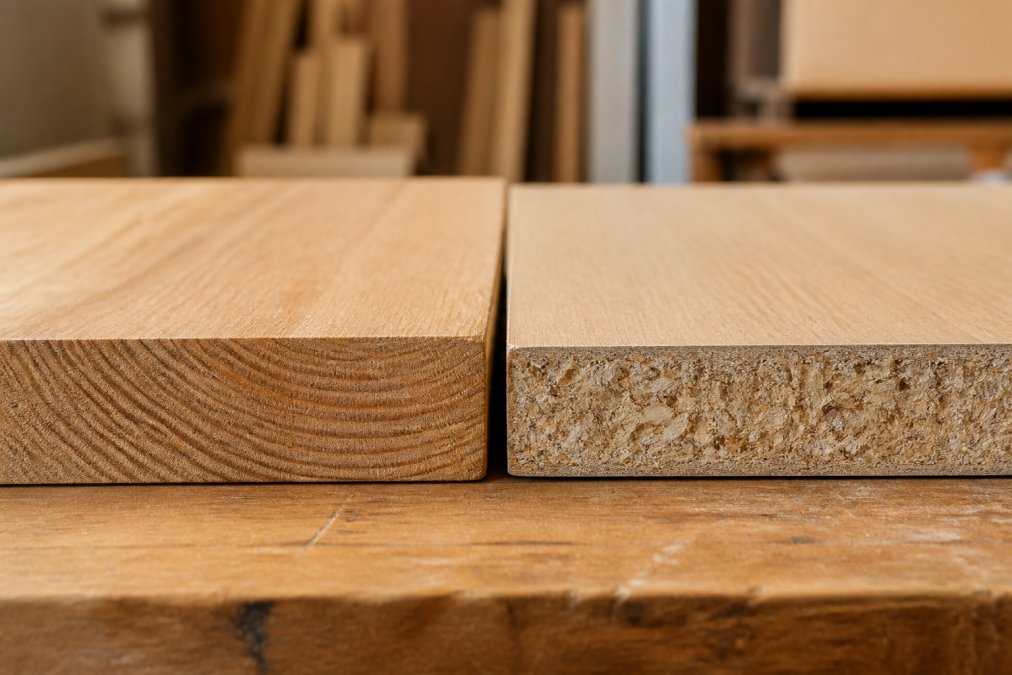
Check the edges and interior surfaces. Solid wood shows grain patterns and natural color throughout. Particle board shows the compressed particle structure, a uniform, grainy surface. If edges are covered with veneer or edge banding, that's a strong indicator the core is not solid wood.
Look at the grain patterns. Solid wood displays natural grain variation with continuous patterns. Particle board with veneer has a uniform, often repeating pattern on the surface only.
Test the weight and feel. Solid wood is substantially heavier than particle board of similar size. Particle board feels lighter and more hollow.
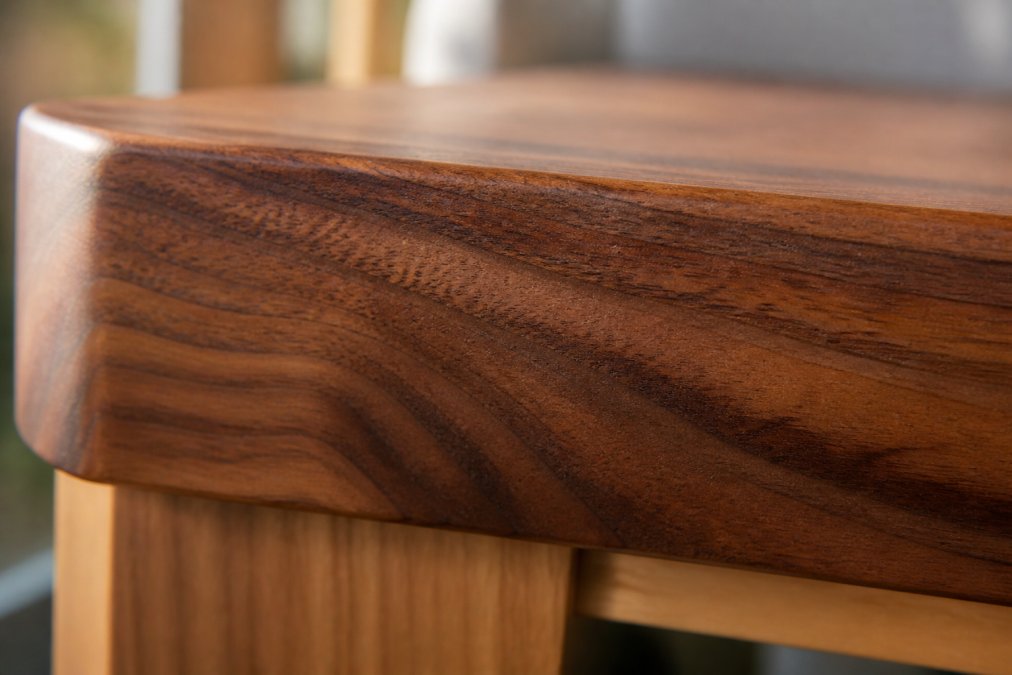
Examine joinery and fasteners. Solid wood uses traditional joints with minimal visible fasteners. Particle board relies on visible screws, dowels, and metal brackets because the material cannot support traditional joinery.
Check for veneering. Run your hand along edges and inside surfaces. If you feel a thin layer of finished wood over a different material beneath, you're looking at veneer over particle board or plywood, not solid wood construction.
Durability, Lifespan, and Load-Bearing Capacity
Solid wood furniture is built to outlast decades of regular use. A well-constructed solid wood table or chair can function for 50 years or longer, improving in appearance as it ages. Hardwoods like oak and walnut are particularly durable because of their density and grain structure.
Particle board furniture typically has a functional lifespan of 5-10 years with moderate use. The material's load-bearing capacity is significantly lower than solid wood. Shelves sag under weight, drawers loosen, and joints fail as resin binders degrade. Once particle board begins to fail, repair is rarely economical.
The cost difference becomes stark over time. A solid wood piece purchased at twice the initial price often costs less per year of use because it remains functional for decades. A particle board piece purchased cheaply may require replacement within five years, making the total cost of ownership higher.
How to Care for Walnut Wood Furniture and Other Hardwoods
Caring for solid wood furniture is straightforward because the material is forgiving and responsive to maintenance.
Dust regularly. Use a soft, dry cloth to remove dust weekly, preventing particles from scratching the surface.
Control humidity. Maintain indoor humidity between 35-55 percent. In dry climates, use a humidifier; in humid climates, ensure adequate ventilation. This prevents excessive shrinking or swelling that can cause cracking or warping.
Email your idea and a few details to MichaelH@pinnaclewoodcraft.net →
Clean with appropriate products. Use a wood-specific cleaner or a simple mixture of water and mild soap. Avoid excessive moisture and wipe surfaces dry immediately. For deeper conditioning, apply a wood conditioner like Howard Products Feed-N-Wax, which contains beeswax and natural oils.
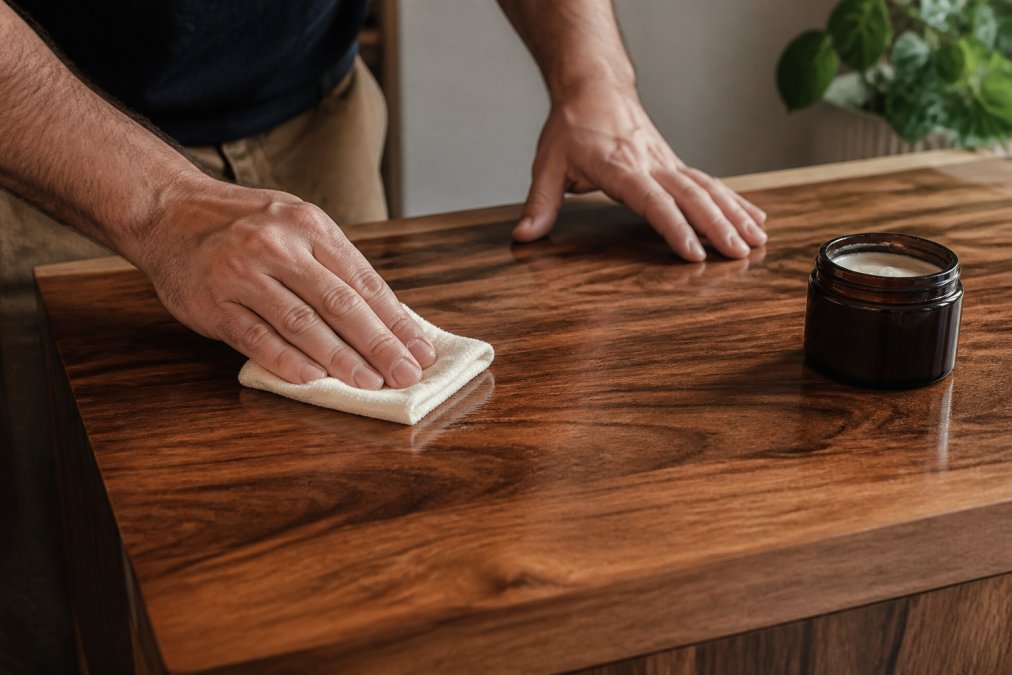
Address spills immediately. Blot water and alcohol spills right away. For stubborn water rings, use a cloth dampened with white vinegar or rubbing alcohol, applied gently and dried immediately.
Repair minor damage promptly. Small scratches and dents can be addressed with touch-up markers or wood filler. The Weiman Wood Furniture Repair Kit provides an affordable option for concealing minor scratches. For deeper gouges, professional refinishing is an option because solid wood can be sanded and re-stained.
Refinish when needed. Unlike particle board, solid wood can be refinished entirely. If the finish becomes worn or damaged, sanding and applying new stain or sealant restores the piece.
Repairing Damaged Particle Board Furniture
Particle board damage is permanent in most cases. The material cannot be restored once it deteriorates, though minor cosmetic damage can be masked.
For small scratches: Use a wood touch-up marker or filler stick that matches the veneer color. The Weiman Wood Furniture Repair Kit works on veneered particle board, though the repair is cosmetic only.
For water damage: If particle board swells or warps from moisture, replacement is the only realistic option. The material cannot be dried and restored.
For loose fasteners: Tighten screws and bolts if accessible. If fasteners pull through the material, the particle board has degraded and the joint is compromised.
For broken shelves or structural failure: Replacement is more economical than repair. Particle board cannot be reinforced or restored.
Particle board furniture is disposable by design. Once it fails, replacement is usually more economical than repair.
Cost, Moisture Resistance, and Long-Term Value
The initial purchase price of particle board furniture is substantially lower than solid wood. However, long-term value tells a different story. A solid wood piece purchased for a higher upfront cost remains functional and attractive for decades. The per-year cost of ownership is lower because you're not replacing it every five years. Solid wood furniture often appreciates in value; a well-maintained piece can be resold or passed down, maintaining much of its original worth.
Particle board depreciates rapidly and has minimal resale value.
Moisture resistance is where the difference becomes critical. Solid wood, when properly finished, resists moisture well. Even if the finish is damaged, the wood can dry out and be refinished. Particle board absorbs moisture readily, swells, and degrades when exposed to humidity or water, making it unsuitable for kitchens, bathrooms, basements, or humid environments.
For furniture you intend to keep and use daily, solid wood is the rational choice.
| Characteristic | Solid Wood | Particle Board |
|---|---|---|
| Material Composition | Real hardwood (walnut, oak, maple, cherry) | Wood chips bonded with formaldehyde resins |
| Lifespan | 30-50+ years with proper care | 5-10 years with moderate use |
| Load-Bearing Capacity | High; supports sustained heavy loads | Low; shelves sag and joints fail under weight |
| Moisture Resistance | Excellent when finished; can be restored if damaged | Poor; swells, warps, and deteriorates when wet |
| Repairability | Excellent; can be sanded, refinished, and jointed | Poor; cannot be jointed or meaningfully repaired |
| Weight | Heavy; indicates solid construction | Light; feels hollow |
| Cost (Initial) | Higher upfront investment | Lower upfront cost |
| Cost (Long-Term) | Lower per-year cost due to longevity | Higher total cost due to frequent replacement |
| Appearance Over Time | Improves with age; develops character and patina | Deteriorates; veneer peels, finish wears |
| Environmental Impact | Renewable if from sustainably managed forests | Uses waste wood but contains synthetic resins |
| Resale Value | Retains value; can be sold or passed down | Minimal; essentially disposable |
When choosing furniture, you're making a decision about the next decade or more of daily use. Solid wood furniture from makers like Pinnacle Woodcraft, LLC represents a commitment to durability and craftsmanship, pieces built with carefully selected lumber, solid joinery, and hand-sanded finishes that age beautifully. Particle board serves a purpose for temporary solutions, but it's not furniture you'll treasure or pass down.
If you're ready to invest in pieces built to last, Pinnacle Woodcraft, LLC specializes in custom solid wood furniture and home accessories crafted with traditional techniques. Every project uses real hardwoods and solid joinery, no particleboard, no shortcuts. Email your vision to MichaelH@pinnaclewoodcraft.net to discuss your custom piece.
Frequently Asked Questions
Is solid wood furniture really better than particle board?
Solid wood furniture typically outlasts particle board by decades. Solid wood develops character over time, can be refinished, and maintains structural integrity through repairs. Particle board, made from wood chips bound with formaldehyde resins, weakens when exposed to moisture and cannot be effectively refinished. For pieces you plan to keep long-term or pass down, solid wood offers superior durability and value, though it requires more maintenance and carries a higher upfront investment.
How can I tell if furniture is real wood or particle board?
Inspect the edges and underside of the piece. Solid wood shows consistent grain patterns and natural wood color throughout. Particle board appears as visible wood chips or has a thin veneer layer covering a grainy, uniform core. Check weight, solid wood is substantially heavier. Press your fingernail into an inconspicuous area; solid wood resists, while particle board dents easily. Listen when tapping; solid wood produces a solid sound, while particle board sounds hollow or dull.
What's the best way to care for walnut wood furniture?
Walnut requires regular conditioning to maintain its rich color and prevent drying. Use a wood polish with beeswax and natural oils every 3-6 months. Keep walnut away from direct sunlight, which fades the grain. Wipe spills immediately to prevent moisture damage and swelling. Maintain stable humidity levels in your home, walnut is sensitive to humidity fluctuations. Avoid harsh chemicals; use mild soap and water for cleaning, then dry thoroughly. A quality conditioner like Howard Feed-N-Wax helps preserve the wood's natural beauty and structural integrity.
Can damaged particle board furniture be repaired?
Minor damage can be concealed using wood filler sticks or touch-up markers designed for particle board. However, structural damage is difficult to repair permanently because particle board lacks the integrity of solid wood. If the piece is water-damaged, swelling is often irreversible. For significant gouges or broken joints, replacement is usually more practical than repair. Unlike solid wood, particle board cannot be refinished to hide wear. Prevention through careful handling and moisture control is your best strategy for extending particle board furniture's lifespan.
This article was written using GrandRanker