comparison
Handmade vs Factory-Made Wooden Decor: What Lasts
Table of Contents
- Handmade vs Factory-Made Wooden Decor: The Core Differences
- Durability and Structural Integrity
- How to Identify Quality Solid Wood Furniture
- Durability of Hand-Sanded Wood Finishes
- Cost Analysis and Long-Term Value
- Modern Farmhouse Style Custom Wooden Decor
- Environmental Impact and Sustainability
- Customization and Personalization Options
Last Updated: August 22, 2026
Handmade vs Factory-Made Wooden Decor: The Core Differences
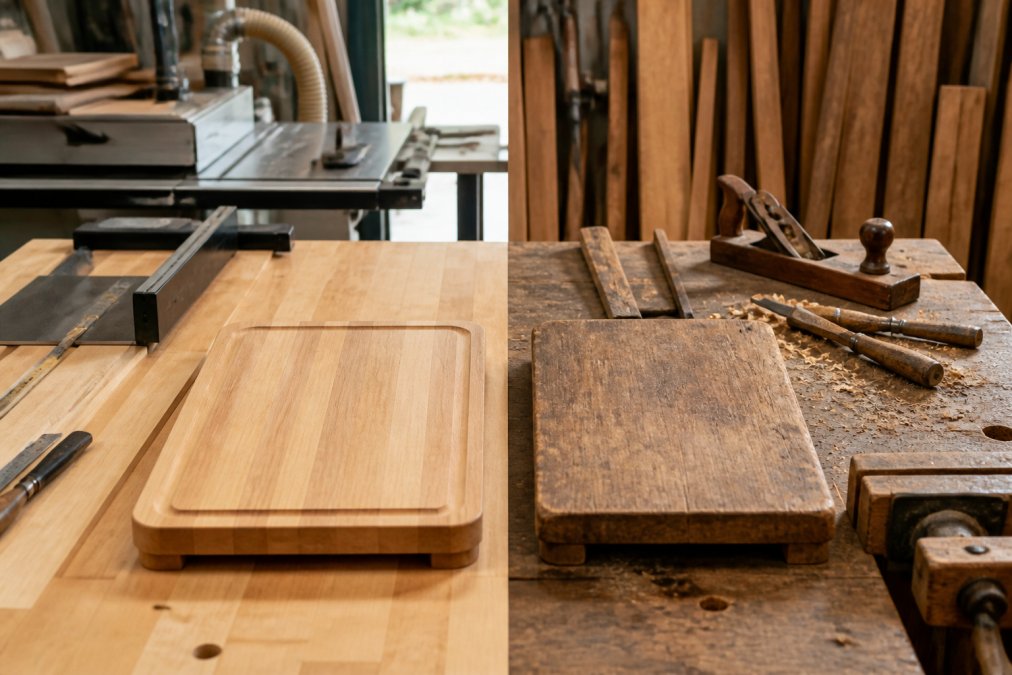
Choosing between handmade and factory-made wooden decor affects durability, longevity, and repairability. Factory-made prioritizes speed and affordability through production lines, dowels, and industrial spray finishes. Handmade follows different logic: craftspeople select specific wood, build joints that lock mechanically without fasteners, and hand-apply finishes across multiple coats. The real question isn't which is "better," but which solves your actual problem. Need affordable decor for a rental? Factory-made makes sense. Want something that becomes a family heirloom? That's where handmade shines.
Durability and Structural Integrity
Solid wood construction determines whether a piece lasts five years or fifty.

Handmade pieces typically rely on traditional joinery, dovetail joints, mortise-and-tenon connections, and frame-and-panel construction, that distribute stress across multiple surfaces. When wood naturally expands and contracts with humidity, these joints accommodate movement rather than fight it. A well-made dovetail joint actually becomes tighter over time.
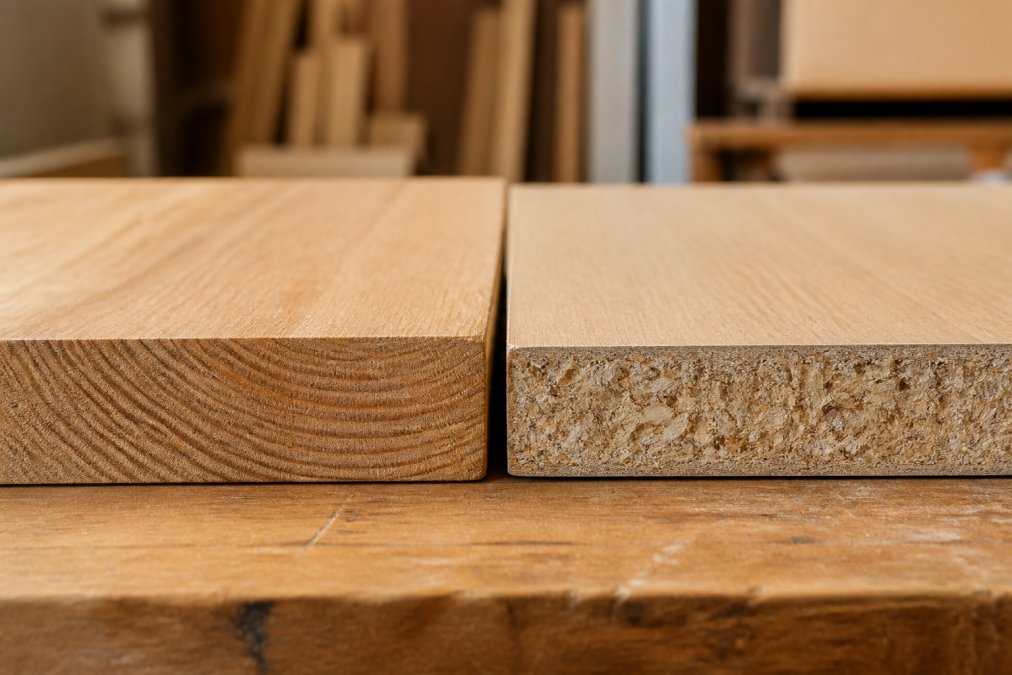
Factory-made decor often uses simpler fastening methods like pocket hole joinery, which depends on screws staying tight, or dowels, which are less forgiving of wood movement. Many mass-produced pieces use veneers over particleboard or plywood, which can't be repaired if damaged and will eventually delaminate.
Handmade craftspeople typically select hardwoods like walnut, cherry, oak, or maple, dense and stable woods. Factory operations often use cheaper softwoods, engineered wood, or veneered substrates to hit price points. A handmade piece with a structural problem can usually be fixed; a joint can be re-glued, a crack filled, a finish refreshed. Factory-made pieces, once something fails, are often headed for the landfill.
Joinery Techniques and Craftsmanship
The way wood is joined determines structural longevity more than any other single factor.
Dovetail joints are the gold standard. Interlocking pins and tails create mechanical strength without fasteners and are nearly impossible to fail. Mortise-and-tenon joints work by inserting a projecting piece (tenon) into a precisely cut cavity (mortise); when properly proportioned and glued, this joint is stronger than the wood itself. Frame-and-panel construction allows wood to move naturally, a solid wood panel floats inside a frame, held by grooves but not glued, preventing splitting and warping. Pocket hole joinery uses screws driven at an angle through one board into another; it's fast but depends on screw integrity and doesn't accommodate wood movement well.
Handmade decor from Pinnacle Woodcraft, LLC uses traditional joinery because it's proven. Factory operations use what's fastest.
Material Quality and Sourcing
Solid hardwood is what you want. Walnut, cherry, maple, and oak are dense, stable, and beautiful. A craftsperson who selects wood carefully considers grain direction, color variation, and moisture content. Wood that's been properly kiln-dried won't warp or crack unexpectedly.
Factory operations source wood by the truckload, optimizing for cost. Veneers, thin slices of nice wood glued to cheaper substrates, look fine initially but delaminate over time, especially in humid environments. Particleboard and medium-density fiberboard (MDF) are cheap and stable for flat panels but can't handle moisture, can't be repaired if damaged, and are heavier than solid wood for the same thickness.
A handmade piece made from solid wood can be sanded, stained, or refinished. The same piece made from veneered particleboard cannot.
How to Identify Quality Solid Wood Furniture
Start by weight. Solid hardwood is dense and heavy; if a piece feels light for its size, it's likely veneered or engineered. Look at the edges, on solid wood, edges show actual wood grain; on veneered pieces, you'll see a thin layer of nice wood glued over a substrate. Check the bottom and interior surfaces; handmade pieces show solid wood throughout, while factory pieces often have veneered tops with particleboard bottoms.
Look for wood movement accommodation. Handmade tables often have breadboard ends or frame-and-panel tops that allow the main surface to expand and contract. Factory pieces typically screw the top down solid, which guarantees eventual cracking or warping.
Examine joinery. Dovetails are visible from the side of drawers on quality pieces. Mortise-and-tenon joints show at corners. Ask about wood species; a craftsperson can tell you exactly what was used and why. Run your hand across the finish; hand-sanded finishes feel smooth and consistent, while factory spray finishes sometimes feel thin or uneven.
Durability of Hand-Sanded Wood Finishes
Hand-sanded finishes are applied in multiple thin coats with sanding between each layer, creating depth and durability. A craftsperson sands progressively finer, starting at 120 grit and moving to 150, then 180, sometimes to 220.
Oil finishes (tung oil, linseed oil) penetrate the wood and harden through oxidation (peer-reviewed research). They're easy to refresh and improve over time as the wood darkens. Lacquer and polyurethane finishes build a protective layer; hand-applied lacquer sanded between coats creates a finish lasting decades, while factory spray finishes are often single or two-coat systems designed to minimize production time.
A hand-sanded finish can be refreshed by sanding lightly and applying another coat. A factory finish that wears through is usually just replaced with a quick spray coat that doesn't match the original depth. In humid environments, a finish that fails allows the wood to swell and crack. Handmade pieces with quality finishes handle this; factory pieces with thin finishes often don't.
Cost Analysis and Long-Term Value
Factory-made wooden decor is cheaper upfront. A mass-produced charcuterie board might cost $25 to $60. A handmade equivalent costs more; contact Pinnacle Woodcraft, LLC directly for a quote.
But "cost" and "value" aren't the same. A factory piece lasting five years costs you the purchase price divided by five years. A handmade piece lasting fifty years costs you the purchase price divided by fifty years. If the handmade piece costs three times as much upfront, it's actually cheaper per year of use.
Factory pieces often need replacement. Over a decade, you might replace a charcuterie board twice. That's three purchases instead of one. Handmade pieces can appreciate in value and become heirlooms passed to your kids. There's also the environmental cost of disposability; every piece you throw away required trees, processing, transportation, and landfill space.
The honest answer: handmade costs more initially. But if you're keeping something for more than ten years, handmade is cheaper per year.
Modern Farmhouse Style Custom Wooden Decor
Modern farmhouse style is about authenticity without rusticity, reclaimed-looking wood, clean lines, and a sense of history without actual decay.

Custom wooden decor fits this aesthetic perfectly because it's literally one-of-a-kind. A factory-produced farmhouse piece is designed to look handmade but isn't; custom pieces actually are handmade, so they have the authenticity the style conveys.
Email your idea and a few details to MichaelH@pinnaclewoodcraft.net →
Modern farmhouse typically uses lighter woods or whitewashed finishes on darker woods. White oak, walnut with a light finish, or reclaimed-looking pine are common. The aesthetic values visible wood grain, simple joinery, and minimal ornamentation. A live edge (the natural edge of the wood) is often featured.
Functional pieces work well: serving boards, valet trays, shelving, small tables, cutting boards. Custom pieces allow you to specify dimensions to fit your space, choose your wood species, and decide on finishes. A craftsperson working in modern farmhouse style will understand that you want something that looks handmade because it is handmade.
Factory-made modern farmhouse decor is often veneered or uses cheaper woods stained to look like something they're not. The difference is immediately obvious to anyone who knows what to look for.
Environmental Impact and Sustainability
The biggest environmental impact of any wooden item is its lifespan. A piece lasting fifty years has one-tenth the environmental cost per year of a piece lasting five years, even if the long-lasting piece required more resources to make (the EPA).
Factory production is efficient in material waste, but factory pieces often use engineered wood, particleboard, and MDF, which require adhesives and processing. Additionally, factory pieces often end up in landfills, contributing to methane emissions.
Handmade pieces waste more wood during production, but that waste is often repurposed, sawdust becomes animal bedding or biofuel, offcuts become smaller projects. Because the final piece lasts much longer, the waste-per-year-of-use is lower.
Sustainable sourcing matters. If environmental impact is important to you, ask the maker where the wood comes from. Handmade craftspeople can usually answer this question. A single piece ships once, not multiple times through the supply chain.
The lifecycle assessment favors handmade when longevity is factored in. Over a fifty-year period, handmade wins environmentally.
Customization and Personalization Options
Factory-made decor comes in fixed sizes, finishes, and styles. Custom wooden decor is built to your specifications. Dimensions can be adjusted to fit your space exactly. Wood species can be chosen to match your existing furniture. Finishes can be customized, lighter or darker, oil or polyurethane, matte or satin. Design elements can be added or removed based on your preferences.
Some craftspeople work with detailed plans you provide; others work collaboratively, refining your description based on their experience. The best custom makers ask good questions: What will this piece be used for? What's your aesthetic? What's your timeline?
Personalization goes beyond aesthetics. You can add initials, dates, or meaningful words. A cutting board with a wedding date. A shelf with a family name. These aren't generic gifts; they're specific to the people receiving them.
The limitation of customization is timeline. Custom work takes time. A simple piece might take two to four weeks. If you need something in two weeks, custom might not be possible.
Choosing between handmade and factory-made wooden decor comes down to what you value. Factory-made wins on price and immediate availability. Handmade wins on longevity, uniqueness, and craftsmanship. If you're looking for something that will last, that fits your space perfectly, and that carries the mark of actual craftsmanship, custom wooden decor from Pinnacle Woodcraft, LLC is worth the investment. Email your idea and a few details to MichaelH@pinnaclewoodcraft.net to explore what's possible.
=== FAQ ANSWERS (audit these too, same rules) ===
[1] Q: Is handmade wooden decor really better than factory-made? A: Handmade wooden decor typically outperforms factory-made in durability, customization, and longevity when crafted with solid wood and proper joinery. Factory-made pieces often use particleboard, veneers, or engineered wood to cut costs, which compromises structural integrity over time. However, 'better' depends on your priorities: if you value uniqueness and lasting investment, handmade wins; if you need budget-friendly decor for temporary styling, factory-made serves that purpose.
[2] Q: Why is handmade wooden decor so much more expensive? A: Handmade pieces cost more because they involve skilled labor, carefully selected materials, and time-intensive techniques like hand-sanding and solid joinery. Each piece is made individually, not mass-produced on assembly lines. Artisans source higher-grade lumber, apply multiple finishing coats by hand, and often customize designs to your specifications. Factory production cuts corners with cheaper materials and automated processes to maximize profit margins. You're paying for quality materials, craftsmanship, and a piece designed to last decades rather than years.
[3] Q: How can you tell if wooden decor is truly handmade and not factory-made? A: Genuine handmade pieces show visible signs of artisan work: natural wood grain variations, hand-sanded surfaces with subtle texture, solid wood construction (no particleboard or veneer), and unique joinery like dovetail joints. Check for maker marks, ask about the woodworker's process, and request photos of the workshop or creation steps. Factory pieces typically have uniform finishes, plastic-like smoothness, visible seams from machine assembly, and identical grain patterns across multiple items. Reputable artisans are transparent about their methods and materials, ask directly.
[4] Q: Does hand-sanded wood finish last longer than factory finishes? A: Hand-sanded finishes applied by skilled artisans often last longer because they involve multiple coats applied carefully to wood that's been properly prepared. The artisan can feel the wood's texture and adjust technique accordingly. Factory finishes are typically spray-applied in one or two coats for speed and cost efficiency, which can leave them more prone to chipping and wearing unevenly. Proper hand-sanded finishes can maintain their appearance with basic care, while factory finishes may show wear depending on use and material quality.
Frequently Asked Questions
Is handmade wooden decor really better than factory-made?
Handmade wooden decor typically outperforms factory-made in durability, customization, and longevity when crafted with solid wood and proper joinery. Factory-made pieces often use particleboard, veneers, or engineered wood to cut costs, which compromises structural integrity over time. However, 'better' depends on your priorities: if you value uniqueness and lasting investment, handmade wins; if you need budget-friendly decor for temporary styling, factory-made serves that purpose.
Why is handmade wooden decor so much more expensive?
Handmade pieces cost more because they involve skilled labor, carefully selected materials, and time-intensive techniques like hand-sanding and solid joinery. Each piece is made individually, not mass-produced on assembly lines. Artisans source higher-grade lumber, apply multiple finishing coats by hand, and often customize designs to your specifications. Factory production cuts corners with cheaper materials and automated processes to maximize profit margins. You're paying for quality materials, craftsmanship, and a piece designed to last decades rather than years.
How can you tell if wooden decor is truly handmade and not factory-made?
Genuine handmade pieces show visible signs of artisan work: natural wood grain variations, hand-sanded surfaces with subtle texture, solid wood construction (no particleboard or veneer), and unique joinery like dovetail joints. Check for maker marks, ask about the woodworker's process, and request photos of the workshop or creation steps. Factory pieces typically have uniform finishes, plastic-like smoothness, visible seams from machine assembly, and identical grain patterns across multiple items. Reputable artisans are transparent about their methods and materials, ask directly.
Does hand-sanded wood finish last longer than factory finishes?
Hand-sanded finishes applied by skilled artisans often last longer because they involve multiple coats applied carefully to wood that's been properly prepared. The artisan can feel the wood's texture and adjust technique accordingly. Factory finishes are typically spray-applied in one or two coats for speed and cost efficiency, which can leave them more prone to chipping and wearing unevenly. Proper hand-sanded finishes can maintain their appearance with basic care, while factory finishes may show wear depending on use and material quality.
This article was written using GrandRanker